We got tired of commercial EM simulators.
AirInduct Sim is a wireless power transfer coil simulator for the browser, iOS and Android, made by AIRINDUCT TECH - FZCOin Dubai Silicon Oasis, Dubai, UAE. We built it because modelling a WPT coil shouldn't require three different tools and a site licence.
AirInduct Sim at a glance
- What it is
- A wireless power transfer (WPT) coil simulator. It computes how strongly two coils couple and the magnetic field they produce.
- How it computes
- Closed-form Biot–Savart (field) and Neumann (mutual inductance) integrals. No mesh, no convergence settings; the same inputs always give the same outputs.
- Coil topologies
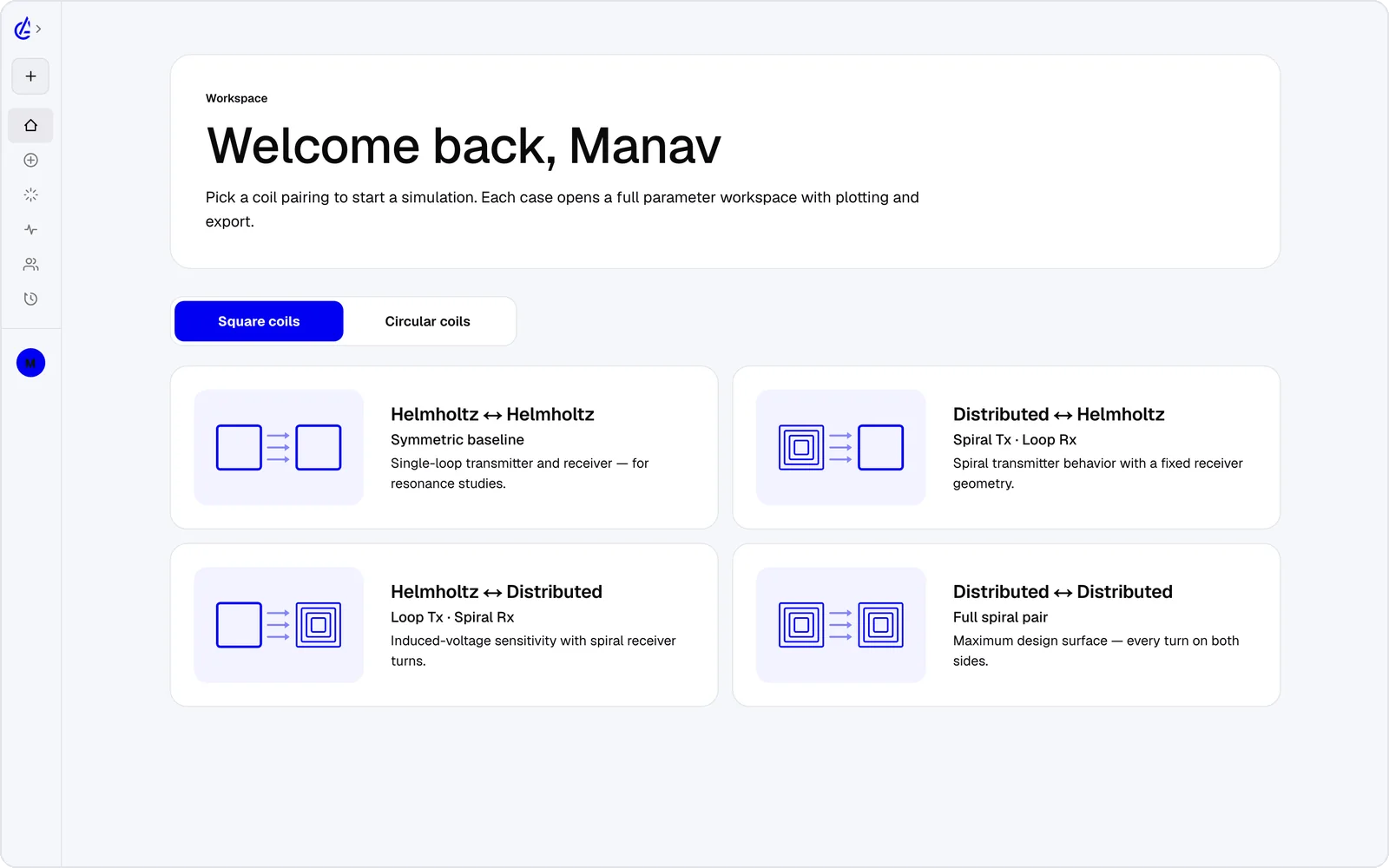
- Eight: circular and square Helmholtz pairs, circular and square DTC (descending-turn planar spiral) pairs, and four Helmholtz–DTC cross pairs.
- Outputs
- Mutual inductance M, self-inductances L_tx and L_rx, coupling coefficient k, induced voltage and peak magnetic field H.
- Design tools
- 3D surface, heatmap and contour plots; parameter sweeps; an optimizer; export to PDF, KiCad, DXF and SPICE.
- AI Copilot
- Operates the app on screen, runs the real solver, analyses links (Q, kQ efficiency, compensation capacitors), checks field exposure against ICNIRP and IEEE reference levels, designs from requirements, and checks every number it states against the solver output.
- For AI agents
- An MCP server at
https://api.airinductsim.com/mcp/(API key required) exposes the same tools as the Copilot. Details. - Where it runs
- In the browser at app.airinductsim.com, and as an iOS and Android app (store listings coming soon). A desktop app for macOS, Windows and Linux is coming soon.
- Free calculators
- Coupling, mutual inductance, Helmholtz, compensation-capacitor and efficiency calculators at /tools, with no account needed.
- Pricing model
- A free plan (Helmholtz topology, 3 simulations a month) and a paid subscription, AirInduct Pro, billed monthly or weekly. Current prices are on the pricing page.
- Also written
- AirInduct, Air Induct, Air Induct Sim, AirInductSim (airinductsim.com)
- Made by
- AIRINDUCT TECH - FZCO
- Registration
- Licence 92951, issued by the Dubai Integrated Economic Zones Authority (Dubai Silicon Oasis).
- Address
- Dtec, Dubai Silicon Oasis, Dubai, United Arab Emirates
- Contact
- info@airinductsim.com
- Website
- airinductsim.com
What AirInduct Sim is not
AirInduct Sim is built for one job: air-core inductive coil pairs. Being clear about the rest saves you from trusting a number outside its range.
- Not a finite-element (FEM) or full-wave solver. It evaluates closed forms for air-core coil pairs; it does not mesh arbitrary 3D geometry.
- Not a model of magnetic materials or metal. Ferrite, shielding plates, enclosures and eddy currents are not modelled, so a shielded EV pad or a coil in a metal case needs a FEM check.
- Not an antenna or radiation tool. The model is magnetostatic, valid for inductive WPT from kilohertz to low megahertz, well below the coil’s self-resonance.
- Not a tilt model. Coils are coaxial with parallel planes; lateral offset is supported, angular misalignment is not.
- Not a SAR or dosimetry tool, and not a medical device. The exposure check compares the free-space field with reference levels only.
- Not a general REST API. Programmatic access is through the MCP server.
The full method and its limits are on the validation page.
What it does
Model 8 coil topologies — 4 square, 4 circular — across every Helmholtz and DTC Tx / Rx combination. Sweep parameters, visualise fields in 2D and 3D, run the optimizer, and export to PDF, KiCad, DXF or SPICE.
How it works
Every field map is computed from the Biot–Savart law. Mutual inductance uses the Neumann formula, evaluated with complete elliptic integrals for circular coils. No surrogate models, no curve fitting — every output traces back to a closed-form integral or its standard numerical reduction, checked against Grover (1946) and Babic & Akyel (2008) on the validation page.