A solver that stands up to peer review.
AirInduct computes the Biot–Savart integral directly — no mesh approximations, no black boxes. Where a closed form exists the solver evaluates it exactly, and every formula it uses can be checked against the literature on the validation page.
How do researchers use AirInduct Sim?
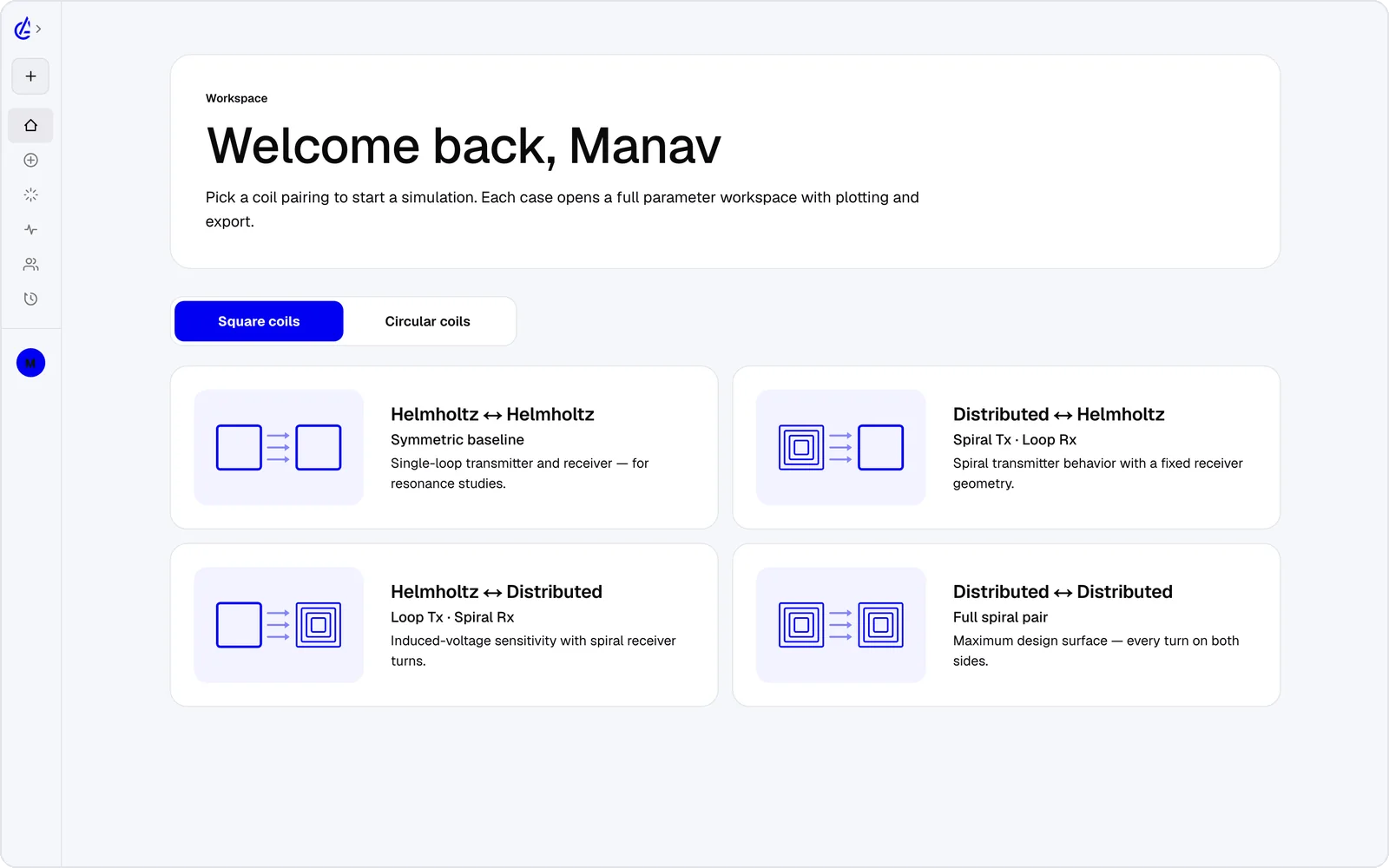
Researchers use AirInduct Sim to generate reproducible coupling and inductance data for inductive wireless power transfer without building a FEM model. Because the solver evaluates closed-form Biot–Savart and Neumann integrals with complete elliptic integrals, identical inputs return identical outputs on every run, and the kernels can be checked against the classic references by Grover (1946) and Babic & Akyel (2008). A typical study fixes a coil pair, sweeps one parameter such as air gap or lateral offset, plots M and k against it, and exports the figures in a PDF report alongside a SPICE netlist for the circuit side. Students can compare all eight topologies, from Helmholtz pairs to DTC planar spirals, in one session. The model is air-core and magnetostatic, so studies of ferrite, shielding or radiation need a FEM or full-wave tool. Batch studies can also be scripted through the AirInduct Sim MCP server.
Validation references
Grover · Inductance Calculations
Self- and mutual-inductance formulas for circular and rectangular coils; the reference the self-inductance check is measured against.
Babic & Akyel · Calculating Mutual Inductance of Circular Coils
The Maxwell–Neumann elliptic-integral form for coaxial circular loops, which the solver evaluates directly.
Teaching and lab use
Running a course or a lab study, or need a topology the engine does not cover yet? Email info@airinductsim.com with your affiliation.
Run the benchmarks.
Frequently asked questions
Is AirInduct Sim suitable for academic WPT research and publication?
Yes. AirInduct uses closed-form Biot–Savart with Neumann mutual-inductance and complete-elliptic-integral kernels — no proprietary heuristics, no mesh approximations, no fitted surrogate models. These are the same analytic expressions derived in the foundational WPT literature (Grover; Babic & Akyel), so within the magnetostatic regime the result is exact rather than approximated, and identical inputs always return identical outputs.
Can I cite AirInduct Sim in a paper?
Yes. Suggested citation: "AirInduct Sim — Browser-based WPT coil simulator with Biot–Savart magnetic field solver and Neumann mutual-inductance kernel. https://airinductsim.com (accessed 2026)."
Can I run batch experiments programmatically?
Yes, through the AirInduct Sim MCP (Model Context Protocol) server at https://api.airinductsim.com/mcp/. With an API key it exposes the same tools as the in-app Copilot — single runs, gap and misalignment sweeps, design comparisons and link analysis — for agent-driven or scripted experiments.
How does AirInduct compare to FEM EM simulators for academic use?
For air-core inductive WPT in the magnetostatic regime, AirInduct evaluates the closed-form expressions that general-purpose FEM simulators approximate on a mesh, so it is fast and fully transparent about its kernels. FEM remains the right tool for ferrite, shielding and eddy currents. We do not publish a head-to-head percentage against those packages.