Precision power, at the body scale.
Medical WPT design operates with the tightest tolerances — small geometries, tight tissue gaps and strict exposure limits. AirInduct Sim models the coil link and screens the field against reference levels; tissue dosimetry stays with dedicated tools.
Can AirInduct Sim design implant wireless power links?
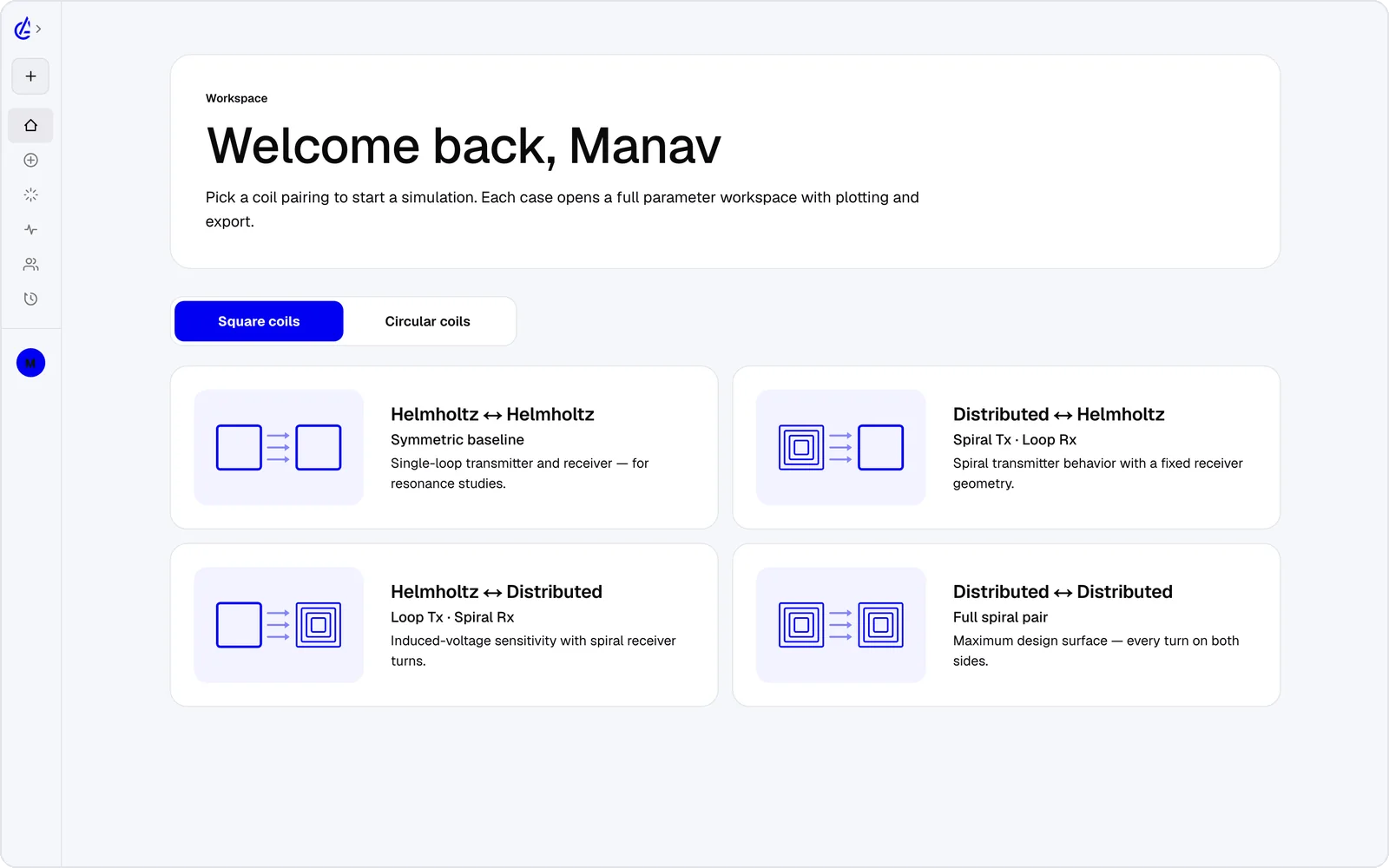
AirInduct Sim can be used to design the coil link of an implant or wearable, but it is an engineering design tool, not a medical device or a dosimetry tool. You model the external transmitter and the implanted receiver as an air-core coil pair, set the tissue gap and lateral offset, and read mutual inductance M, coupling k, induced voltage and peak magnetic field in seconds. The AI Copilot can then check the free-space field against ICNIRP 2010/2020 or IEEE C95.1-2019 reference levels and report the margin in dB, and analyse the link for Q, kQ efficiency and compensation capacitors at bands such as 6.78 MHz. AirInduct Sim does not model human tissue, SAR, induced electric fields in the body or heating, so a regulatory submission still needs dosimetry with anatomical body models and physical testing. Use it to narrow the geometry quickly before that validation step.
Implants
Transcutaneous power transfer for pacemakers, cochlear implants and neural stimulators. Millimetre-scale coil geometries with tight efficiency targets at 6.78 MHz ISM.
Wearables
Hearing aids, continuous glucose monitors, on-skin patches — low-profile receivers for on-body charging.
Geometry within limits
Sweep turns, coil size and gap to find the smallest receiver that still meets the coupling target your fabrication constraints allow.
Exposure check
The AI Copilot compares the free-space magnetic field with ICNIRP and IEEE C95.1 reference levels and reports the margin. It is a screening step, not a SAR assessment.
Disclaimer
AirInduct is a research and design tool — it is not a medical device and is not cleared for clinical decision-making. Always validate against physical prototypes and regulatory testing.
Design at body scale.
Frequently asked questions
What frequency is best for biomedical implant wireless power?
The 6.78 MHz AirFuel Resonant ISM band is the most common for transcutaneous implant power because tissue absorption is moderate and coil sizes stay millimetric. AirInduct simulates 6.78 MHz and the adjacent 13.56 MHz band directly.
Can I model the 8–25 mm tissue gap typical for cochlear or pacemaker links?
Yes. Set axial gap and lateral offset; the simulator returns coupling coefficient k and mutual inductance M for every grid point so you can map alignment-tolerance volumes for the implant.
Is this a free alternative to FEM EM simulators for biomedical WPT?
For the coil link, yes, and it is free to start. AirInduct covers the air-core inductive regime of many FEM-based implant studies, but it does not model tissue or SAR. For coupled SAR/thermal validation against IEEE C95.1, pair AirInduct with a full multi-physics FEM as the certification step.
Does AirInduct support the small (mm-scale) coils used in neurostimulators?
Yes — the analytical Biot–Savart kernel handles millimetre-scale implant coils as well as larger pads without any mesh refinement loop.