COMSOL vs Ansys Maxwell for WPT coils.
The two finite element suites most wireless power teams shortlist, compared on what decides a coil project: meshing, physics coupling, circuits, scripting and licences — plus where a fast air-core tool fits before either.
Last reviewed: October 2026
Two philosophies of finite element analysis
Ansys Maxwell, part of Synopsys since the July 2025 acquisition of Ansys, is a dedicated low-frequency electromagnetics solver. It solves magnetostatic, eddy-current and transient problems in 2D, axisymmetric and 3D, and its signature feature is automatic adaptive meshing: it refines the mesh pass by pass until inductance and energy converge.
COMSOL Multiphysics is a general finite element platform. For coils you add the AC/DC Module, which brings magnetic field interfaces, homogenised multi-turn coil features and inductance matrix extraction. Its strength is that any physics can share one model: one geometry can carry heat transfer, structural mechanics or your own equations. You get more control, and more responsibility for meshing choices.
COMSOL vs Ansys Maxwell vs AirInduct Sim
How the two FEM suites compare for wireless power coils, with AirInduct Sim alongside for the exploration stage.
| Criterion | COMSOL Multiphysics | Ansys Maxwell | AirInduct Sim |
|---|---|---|---|
| Owner | COMSOL AB | Synopsys (Ansys acquired July 2025) | AIRINDUCT TECH - FZCO |
| Solver and meshing | FEM; physics-controlled mesh you can tune by hand, with adaptive refinement available | FEM; automatic adaptive meshing that refines until the solution converges | Closed-form Biot–Savart + Neumann mutual inductance, no mesh |
| 2D / 3D | 2D, axisymmetric and 3D | 2D, axisymmetric and 3D | 3D fields |
| Physics coupling | Any physics in one model: heat transfer, structural, user-defined equations | Electromagnetics core; thermal and structural via other Ansys tools | Magnetics of air-core coils only |
| Ferrite, shields, eddy currents | Yes, AC/DC Module material library and nonlinear B-H | Yes, nonlinear materials and core loss | Not modelled |
| Circuit co-simulation | Electrical Circuit interface inside the same model | Circuit coupling and reduced-order models with Twin Builder (formerly Simplorer) | SPICE export of the coupled coils |
| Scripting | COMSOL API for Java, LiveLink for MATLAB, Application Builder | Python via PyAEDT, plus built-in IronPython scripting | AI Copilot and MCP server drive the real solver |
| Install / platform | Desktop, Windows, macOS and Linux | Desktop (Electronics Desktop), Windows and Linux | Browser, plus iOS and Android apps |
| Licence model | Commercial, quote-based; add-on modules | Commercial, quote-based | Free plan + Pro subscription |
| Free option | No free student edition; academic licences via institutions | Electronics Desktop Student, free with mesh limits | Free plan: Helmholtz topology, 3 simulations a month |
| AI assistant | Chatbot window since 6.3 (Windows; your own LLM API key) | Ansys Engineering Copilot, from 2025 R2 | AI Copilot that runs the solver |
| Time to first result | Minutes to hours | Minutes to hours | Seconds |
| WPT outputs (L, M, k) | Inductance matrix; you derive k | Inductance matrix and coupling | L, M and k on every run |
Competitor details are taken from public vendor pages and documentation, last reviewed October 2026. Product names are trademarks of their respective owners and are used only to identify them. AirInduct is not affiliated with, endorsed by or sponsored by any of these vendors.
Physics, materials and circuits
For a production charger, both model ferrite tiles with nonlinear B-H curves, aluminium shield plates, eddy-current loss and coil resistance at frequency. The difference is how far beyond electromagnetics you go. If the question is how hot the receiver pad runs, or how a shield deforms, COMSOL keeps it in one model. Maxwell hands those studies to other Ansys tools.
Circuits split the same way. Maxwell users typically pair it with Twin Builder (formerly Simplorer), coupling the field model or a reduced-order model to the inverter and compensation network to check switching behaviour and efficiency. COMSOL embeds its Electrical Circuit interface in the field model, which keeps a series-series resonant tank inside one file; Twin Builder offers the fuller system-simulation environment for switching converters.
Scripting, AI and licences
Maxwell automation now runs through PyAEDT, an open-source Python library for Ansys Electronics Desktop, alongside the long-standing built-in IronPython scripting. COMSOL offers the COMSOL API for Java, LiveLink for MATLAB, and the Application Builder for turning a model into a simple app colleagues can run with set inputs.
Both added AI assistants. Ansys Engineering Copilot arrived in Maxwell with 2025 R2. COMSOL introduced a Chatbot window in version 6.3 that generates and debugs API code; it runs on Windows and needs your own API key for a supported language model.
Both are commercial, quote-based licences. Ansys Electronics Desktop Student, which includes Maxwell, is a free download for educational use with mesh limits; COMSOL has no equivalent free student edition. For each tool in depth, see our COMSOL alternative and Ansys Maxwell alternative pages.
Where AirInduct Sim fits before either
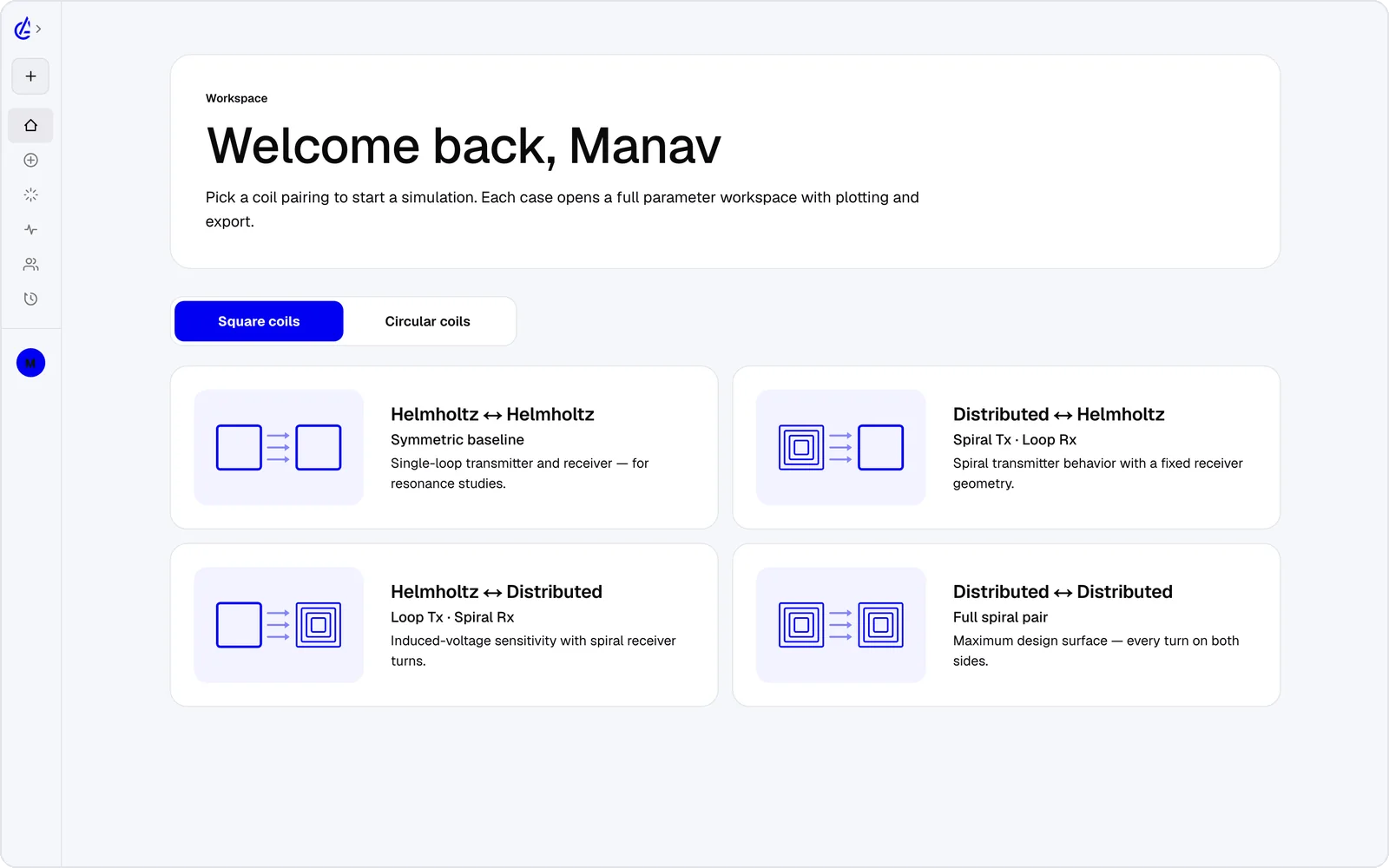
Every new turn count or radius in a FEM model means remeshing. AirInduct Sim does the step before that. It computes the field with closed-form Biot–Savart and coupling with the Neumann integral, so an air-core coil pair solves in seconds from one of eight topology presets, with L, M and k on every run.
Use it to sweep gap and misalignment, run the genetic optimizer, and export the winner as DXF for import into COMSOL or Maxwell, where you add ferrite and shielding. It does not model those materials, so it does not replace either suite for sign-off. It is free to start: the free plan covers the Helmholtz topology with 3 simulations a month, and AirInduct Pro unlocks every topology, the AI Copilot and unlimited runs (see pricing). Check the validation cases first, or compare all eight tools in the best WPT simulation software.
Which should I use?
Choose Ansys Maxwell if your work is mainly electromagnetics with power electronics, and COMSOL Multiphysics if the coil sits inside a wider coupled problem; use AirInduct Sim before either to explore air-core geometry fast. Maxwell's automatic adaptive meshing and its Twin Builder link make it the faster route to converged inductance and circuit-level efficiency for EV pads and chargers. COMSOL's single-model multiphysics makes it stronger when heating, mechanics or custom equations matter as much as coupling, and its Java and MATLAB interfaces suit research groups. Accuracy is not the deciding factor: both are mature and agree when converged. Licensing often decides, so use whichever your organisation already holds. Students get a free Maxwell edition; COMSOL usually needs a university licence. Either way, screening dozens of air-core variants in AirInduct Sim first means you build only one or two FEM models instead of twenty.
Compare with other tools
See all 20 AirInduct Sim alternatives and comparisons →Pick the coil first. Mesh it second.
Frequently asked questions
Is COMSOL or Ansys Maxwell more accurate for coil inductance?
Both are mature finite element solvers and agree closely on a well-meshed model. Accuracy depends more on mesh convergence, material data and boundary placement than on the brand. Maxwell automates mesh convergence; in COMSOL you check it yourself.
Can students use COMSOL or Maxwell for free?
Ansys Electronics Desktop Student, which includes Maxwell, is a free download for educational use with mesh limits. COMSOL has no free student edition; students usually work through a university licence.
Which is better for circuit-level WPT simulation?
Maxwell pairs with Twin Builder for power-electronics co-simulation and reduced-order models. COMSOL couples its Electrical Circuit interface directly into the field model. Both handle compensation networks; pick the one your team already scripts.
Where does AirInduct Sim fit if I already own COMSOL or Maxwell?
Before them. AirInduct Sim screens air-core coil geometries in seconds, so you build only the most promising candidate as a FEM model, then add ferrite and shielding there.