The MEEP alternative for coils.
MEEP is one of the best tools in computational photonics. It was never meant for wireless power coils, which live at wavelengths a million times larger than the device. AirInduct Sim covers that regime with the right physics.
Last reviewed: October 2026
What MEEP does well
MEEP is an FDTD package developed at MIT and maintained by the NanoComp group under the GNU GPL. It is scripted in Python, with an older Scheme interface and a C++ library underneath, and runs in 1D, 2D, 3D and cylindrical coordinates with MPI on clusters. Its units are dimensionless and scale-invariant: you pick a length a, and frequency is simply a/λ, so one simulation describes a whole family of device sizes.
Researchers choose it for photonic crystals, waveguides, ring resonators, metasurfaces and plasmonics. Subpixel smoothing gives accurate results on coarse grids with curved dielectric interfaces. Harminv extracts resonant frequencies and Q factors, and the companion MPB eigensolver supplies band structures and eigenmode sources. Its adjoint solver drives inverse design and topology optimisation, and GDSII import brings in chip layouts. For nanophotonics it is a standard reference.
Where AirInduct Sim is faster for WPT coils
MEEP’s strengths turn against you at low frequency. The time step is a fixed fraction of the grid spacing, so a coil a millionth of a wavelength across needs tens of millions of steps for a single cycle. Meep also reports fluxes, spectra and modes rather than inductance, so you would be building the circuit view yourself.
AirInduct Sim treats the coil as what it is at 85 kHz to 6.78 MHz: a quasi-static magnetic problem. Closed-form Biot–Savart and the Neumann integral give:
- Self-inductance, mutual inductance M and coupling k in seconds, in SI units.
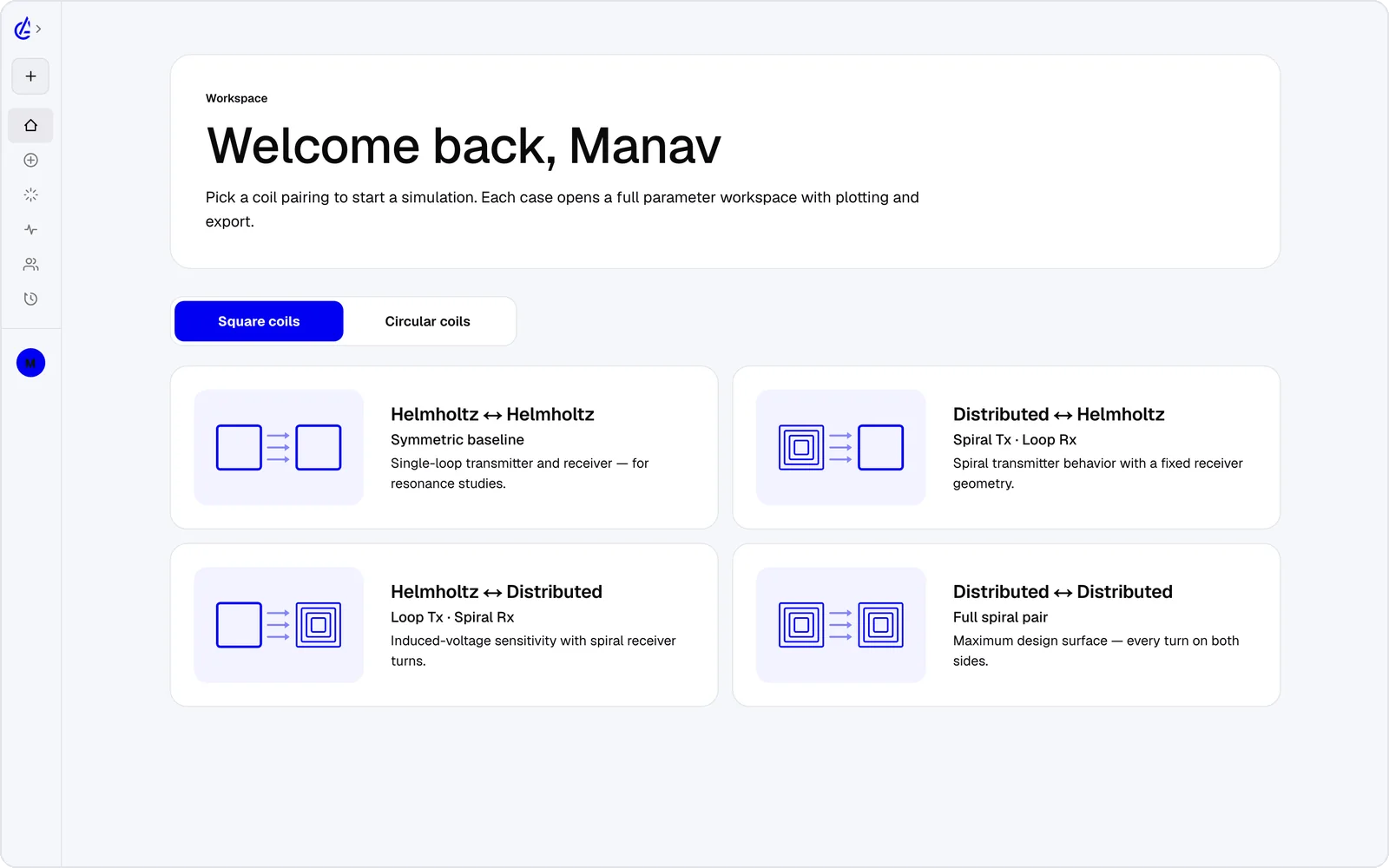
- Eight presets: circular and square Helmholtz pairs, descending-turn (DTC) spirals and cross pairs.
- 3D field plots, parameter sweeps and a genetic optimizer.
- An AI Copilot that runs the real solver, and an MCP server for agents.
It is free to start: the free plan covers the Helmholtz topology with 3 simulations a month; AirInduct Pro unlocks every topology, the AI Copilot and unlimited runs (see pricing).
MEEP vs AirInduct Sim at a glance
A photonics FDTD code against a quasi-static coil solver.
| Criterion | AirInduct Sim | MEEP |
|---|---|---|
| Solver method | Closed-form Biot–Savart field + Neumann mutual inductance, no mesh | Finite-difference time-domain (FDTD) on a Yee grid with subpixel smoothing |
| 3D | Full 3D B and H fields, interactive 3D plots | 1D, 2D, 3D and cylindrical coordinates |
| Install | None — runs in the browser, plus iOS and Android apps | Conda packages or build from source; Python scripts, MPI for clusters |
| Licence / price model | Free plan + Pro subscription | Open source, GNU GPL (v2 or later), free to use |
| Time to first result | Seconds from a topology preset | Minutes for a 2D photonic test; impractical for a kHz coil |
| WPT outputs (L, M, k) | Self-inductance, mutual inductance M and coupling k on every run | Not a native output: Meep reports fluxes, spectra, modes and Q, not circuit inductance |
| Units | SI: millimetres, turns, amps, hertz | Dimensionless, scale-invariant units (c = 1, lengths in a chosen unit a) |
| Inverse design | Genetic optimizer over coil parameters | Adjoint solver for density-based topology optimisation |
| Export | PDF report, KiCad, DXF, SPICE | HDF5 field output and NumPy arrays from Python |
| AI assistance | AI Copilot that drives the app and runs the real solver; MCP server for agents | None built in |
Competitor details are taken from public vendor pages and documentation, last reviewed October 2026. Product names are trademarks of their respective owners and are used only to identify them. AirInduct is not affiliated with, endorsed by or sponsored by any of these vendors.
When to stay with MEEP
Stay with MEEP for anything optical or where the structure is comparable to the wavelength: photonic band gaps, grating couplers, resonator Q, dispersive or nonlinear materials, and inverse-designed photonic components. If your paper needs transmission spectra or a topology-optimised device, AirInduct Sim is not a substitute.
It is also the open, reproducible choice for teaching computational electromagnetics. AirInduct Sim models air-core coils only — no radiation, magnetic materials or multiphysics.
Using both in a photonics lab
Photonics groups often need coils too: magnetic bias fields for magneto-optics, atomic-physics traps or Faraday rotators. Keep each tool on its own job:
- Design the optical device in MEEP as usual.
- Design the bias coils in AirInduct Sim: pick a Helmholtz preset, sweep radius and spacing for field uniformity, and read off the inductance your current driver sees.
- Export DXF for the mechanical mount, KiCad for a PCB coil, SPICE for the driver and a PDF report for the lab notebook.
- There is no reason to import the coil into MEEP; at kHz–MHz its field is quasi-static.
See the export formats and how the solver is validated.
Which should I use?
Use AirInduct Sim for air-core coils between kilohertz and a few megahertz, and MEEP for photonics and other problems where the structure is comparable to the wavelength. The two tools barely overlap. MEEP’s dimensionless units, subpixel smoothing, MPB eigenmodes and adjoint inverse design make it a reference for nanophotonics, but its time step is tied to the grid, so a wireless power coil costs tens of millions of steps per cycle and still returns fluxes rather than inductance. AirInduct Sim returns self-inductance, mutual inductance and coupling in seconds, with Helmholtz presets that also suit the bias coils many optics labs build. If you are a computational photonics researcher who needs a coil, design it in AirInduct Sim and keep MEEP for the optical device. If your problem is radiation, dispersion or optical resonance, AirInduct Sim is the wrong tool and MEEP is the right one.
Compare with other tools
See all 20 AirInduct Sim alternatives and comparisons →Coils in SI units, not a/λ.
Frequently asked questions
Why is Meep a poor fit for an 85 kHz coil?
Its time step is a fixed fraction of the grid spacing. With 1 mm units at 10 pixels per unit, one 85 kHz period is about 70 million steps, while the coil is a millionth of a wavelength. A quasi-static solver is the right physics.
Can Meep’s adjoint solver design a wireless power coil?
Not usefully. The adjoint solver optimises a permittivity distribution on a voxel grid, which suits photonic devices, not wound copper. AirInduct Sim’s genetic optimizer searches turns, radii and spacing directly for mutual inductance and coupling.
Can AirInduct Sim design the bias coils for an optics experiment?
Yes, if they are air-core. Many photonics and atomic-physics labs need Helmholtz pairs for a uniform magnetic bias field. AirInduct Sim maps that field in 3D and reports the inductance your current driver will see.