The openEMS alternative for kHz coils.
openEMS is the open-source full-wave solver RF engineers and makers use for antennas and PCB RF. Wireless power coils at 85 kHz to 6.78 MHz are a different problem, and AirInduct Sim is built for that one.
Last reviewed: October 2026
What openEMS does well
openEMS, written by Thorsten Liebig under GPLv3, is a full-wave equivalent-circuit FDTD (EC-FDTD) solver. It runs in 3D on Cartesian or cylindrical graded grids, with multi-threading and MPI. Geometry is described with CSXCAD from Octave, MATLAB or Python, checked in AppCSXCAD, and fields are viewed in ParaView.
That has made it a favourite of RF engineers, radio amateurs and the open-hardware community for patch and horn antennas, microstrip filters and PCB signal integrity; the method itself grew out of MRI coil research. It has lumped ports, dispersive materials, a near-to-far-field transform and SAR, and the scripts are plain text you can version.
Where AirInduct Sim is faster for WPT coils
The issue is physics. An explicit FDTD solver obeys the Courant limit, so its time step is tied to the smallest cell. With 1 mm cells that step is about 2 picoseconds. One cycle at 85 kHz lasts 11.8 microseconds — roughly six million steps — and a resonant WPT link needs many cycles to settle. At 6.78 MHz it is still tens of thousands of steps per cycle.
Below a few megahertz a coil is a tiny fraction of a wavelength, so the field is quasi-static. AirInduct Sim uses closed-form Biot–Savart and the Neumann integral instead:
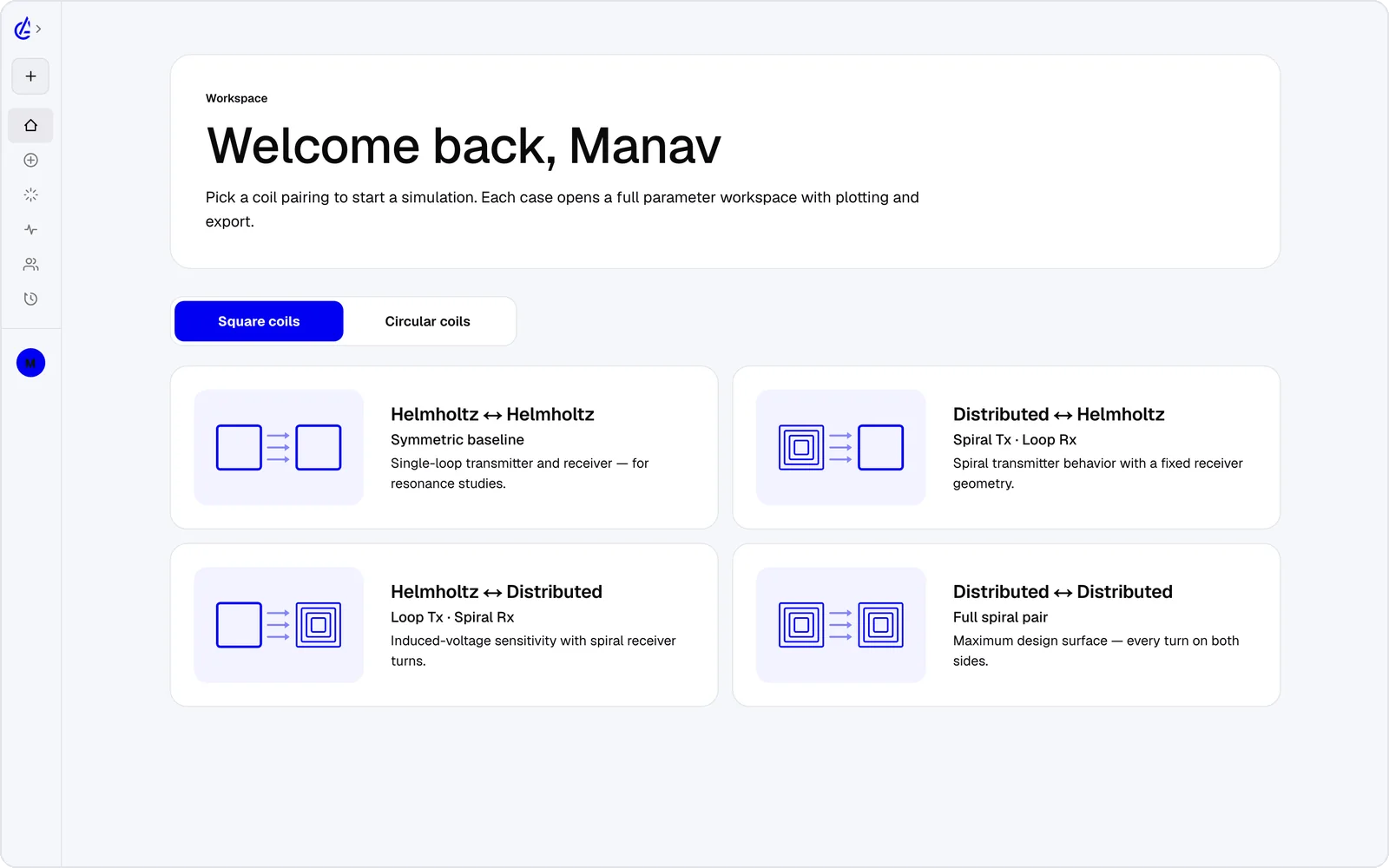
- Eight presets — circular and square Helmholtz, descending-turn (DTC) spirals and cross pairs — instead of a CSXCAD script.
- Self-inductance, mutual inductance M and coupling k on every run, with no Z-parameter post-processing.
- Gap, misalignment and turn-count sweeps plus a genetic optimizer.
- 3D field plots in the browser.
- An AI Copilot that runs the real solver, and an MCP server for your own agents.
It is free to start: the free plan covers the Helmholtz topology with 3 simulations a month; AirInduct Pro unlocks every topology, the AI Copilot and unlimited runs (see pricing).
openEMS vs AirInduct Sim at a glance
Full-wave time domain against closed-form quasi-statics.
| Criterion | AirInduct Sim | openEMS |
|---|---|---|
| Solver method | Closed-form Biot–Savart field + Neumann mutual inductance, no mesh, no time stepping | Equivalent-circuit FDTD (EC-FDTD), full-wave, explicit time stepping on a rectilinear grid |
| 3D | Full 3D B and H fields, interactive 3D plots | Full 3D in Cartesian or cylindrical coordinates, graded mesh |
| Install | None — runs in the browser, plus iOS and Android apps | Build or install openEMS + CSXCAD; scripted from Octave/MATLAB or Python |
| Licence / price model | Free plan + Pro subscription | Open source, GPLv3, free to use |
| Time to first result | Seconds from a topology preset | Write the script, mesh it, then wait for the time loop; long at kHz frequencies |
| WPT outputs (L, M, k) | Self-inductance, mutual inductance M and coupling k on every run | Port voltages and currents; you derive Z-parameters and then L, M and k yourself |
| Frequency range it suits | Quasi-static WPT, roughly 85 kHz to 6.78 MHz and beyond while the coil stays small against the wavelength | RF and microwave, where the structure is a sizeable fraction of a wavelength |
| Radiation, far field, SAR | Not modelled | Yes: near-to-far-field transform, radiation patterns, SAR |
| Export | PDF report, KiCad, DXF, SPICE | VTK and HDF5 field dumps for ParaView, port data via scripts, CSXCAD XML geometry |
| AI assistance | AI Copilot that drives the app and runs the real solver; MCP server for agents | None built in |
Competitor details are taken from public vendor pages and documentation, last reviewed October 2026. Product names are trademarks of their respective owners and are used only to identify them. AirInduct is not affiliated with, endorsed by or sponsored by any of these vendors.
When to stay with openEMS
Stay with openEMS whenever the wavelength matters. At 13.56 MHz, for NFC tags and readers, the time-step count is manageable and openEMS shows self-resonance, matching and radiation. For a charger’s radiated emissions, antenna patterns or SAR, AirInduct Sim does not answer the question; openEMS does.
It is also the better fit for a fully open pipeline you can audit, or a coil next to metal: openEMS can include conductors, while AirInduct Sim models air-core coils only.
From AirInduct Sim to an openEMS script
- Size the coil pair in AirInduct Sim: pick a preset, sweep turns and offset, and let the optimizer pick a candidate.
- Export the PDF report (turns, radii, pitch) and a SPICE model for the resonant capacitors.
- For a PCB coil, export to KiCad and convert the Gerbers with a community flow such as Antmicro’s gerber2ems; rebuild a wire coil in a short CSXCAD script.
- Add a lumped port and check the inductance matches AirInduct Sim before studying resonance, emissions or metal.
See the export formats and how the solver is validated.
Which should I use?
Use AirInduct Sim to design air-core wireless power coils between about 85 kHz and 6.78 MHz, and openEMS when the wavelength starts to matter. The deciding factor is the time step: an explicit FDTD solver advances in picoseconds, so a kilohertz link costs millions of steps per cycle, while a closed-form Biot–Savart and Neumann solver returns inductance, mutual inductance and coupling in seconds. That makes AirInduct Sim the faster way to explore turns, radius, gap and misalignment for EV pads, implant links and Qi-style chargers. openEMS remains the right open-source tool for 13.56 MHz NFC antennas, self-resonance, radiated emissions, PCB RF and antennas, and it can include nearby metal that AirInduct Sim does not model. Makers and RF engineers who already know CSXCAD can use both: AirInduct Sim to choose the coil, openEMS to check how it behaves at frequency.
Compare with other tools
See all 20 AirInduct Sim alternatives and comparisons →Skip six million time steps.
Frequently asked questions
Can openEMS simulate an 85 kHz wireless charging coil?
It can, but slowly. FDTD time steps are set by the smallest cell, around picoseconds, while one 85 kHz cycle lasts almost 12 microseconds — millions of steps per cycle. A quasi-static solver such as AirInduct Sim gets L, M and k directly.
Is openEMS a good choice for a 13.56 MHz NFC antenna?
A reasonable one. At 13.56 MHz the step count is far lower than at 85 kHz, and openEMS shows tuning, matching and stray radiation. AirInduct Sim is still quicker for sizing the coil geometry itself.
Do I need MATLAB to use openEMS?
No. openEMS is scripted from Octave or MATLAB, and also has Python bindings, so a fully free toolchain is possible. AirInduct Sim needs neither: it runs in a browser, with iOS and Android apps.
Can I take a coil from AirInduct Sim into openEMS?
Yes, by rebuilding it: recreate the coil in a CSXCAD script from the PDF report’s dimensions, or for a PCB coil export to KiCad and use a Gerber-based flow such as gerber2ems.