The 3D FEMM alternative for WPT coils.
FEMM is the free 2D finite element tool that a generation of engineers learned magnetics on. For coaxial coils it is excellent. AirInduct Sim picks up where 2D stops: offsets, square and spiral pads, and 3D fields, in a browser.
Last reviewed: October 2026
What FEMM does well
FEMM (Finite Element Method Magnetics), written by David Meeker, is a free finite element suite for 2D planar and axisymmetric problems. It solves magnetostatics and time-harmonic magnetics with eddy currents, alongside electrostatics, heat flow and current flow, in one compact Windows program.
For coil work the axisymmetric solver is the hidden gem. Two coaxial circular coils are a genuinely axisymmetric problem, so FEMM computes their flux linkage, self-inductance and mutual inductance accurately in seconds, with ferrite or a metal plate included. Lua scripting, pyFEMM, OctaveFEMM for Octave and MATLAB, and a Scilab toolbox make it easy to batch hundreds of runs.
Where AirInduct Sim is faster for WPT coils
AirInduct Sim is built for the cases FEMM cannot draw. A phone on a pad or an implant under skin sits at some lateral offset, which breaks axisymmetry and takes the problem out of 2D.
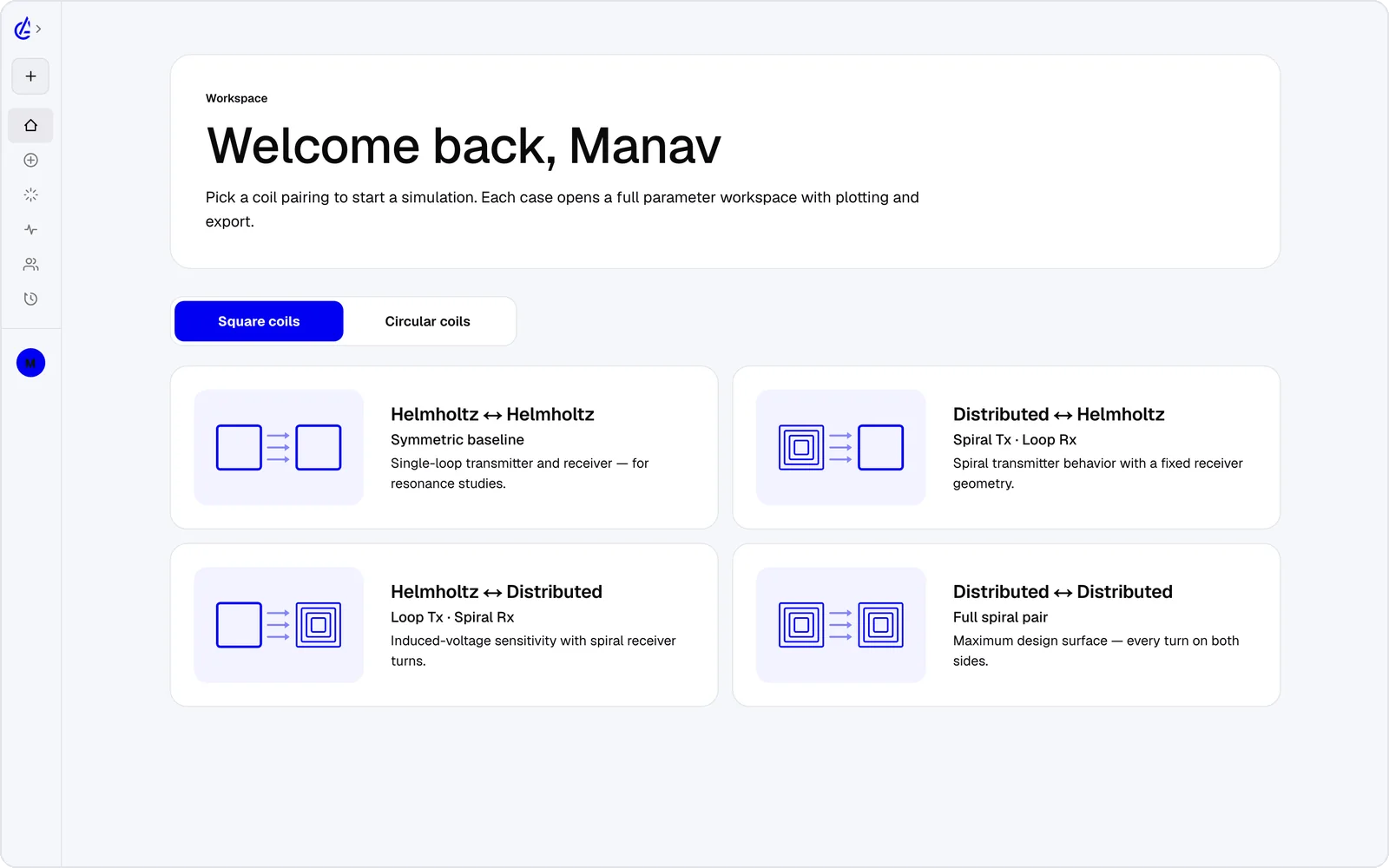
- Lateral misalignment and gap sweeps on the true 3D geometry, using closed-form Biot–Savart and the Neumann integral rather than a mesh.
- Square Helmholtz coils, descending-turn (DTC) planar spirals and cross pairs such as circular Helmholtz–DTC, none of which FEMM can represent.
- L, M and k on every run, with no flux-linkage script.
- 3D field plots and a genetic optimizer in any browser, plus iOS and Android apps — no Windows machine and no Wine.
- An AI Copilot that drives the app and runs the real solver, and an MCP server for your own agents.
It is free to start: the free plan covers the Helmholtz topology with 3 simulations a month, and AirInduct Pro unlocks every topology, the AI Copilot and unlimited runs (see pricing).
FEMM vs AirInduct Sim at a glance
Where a 2D axisymmetric FEM tool and a 3D closed-form coil solver differ for WPT work.
| Criterion | AirInduct Sim | FEMM |
|---|---|---|
| Solver method | Closed-form Biot–Savart field + Neumann mutual inductance, no mesh | Finite element method on a triangular mesh (Triangle mesher) |
| 3D | Full 3D B and H fields, interactive 3D plots | No — 2D planar and axisymmetric only |
| Install | None — runs in the browser, plus iOS and Android apps | Windows desktop install; runs on Linux and macOS under Wine |
| Licence / price model | Free plan + Pro subscription | Free of charge under the Aladdin Free Public License |
| Time to first result | Seconds from a topology preset | Minutes: draw the cross-section, assign materials and circuits, mesh, solve |
| WPT outputs (L, M, k) | Self-inductance, mutual inductance M and coupling k on every run | Flux linkage and inductance from circuit properties; M and k by post-processing two solves |
| Lateral misalignment | Any offset or gap, swept directly | Not representable — an offset breaks axisymmetry |
| Ferrite, metal, eddy currents | Not modelled — air-core coils only | Yes, including nonlinear B-H curves and time-harmonic eddy currents |
| Scripting | Parameter sweeps + genetic optimizer in the app; MCP server | Lua scripting, plus pyFEMM, OctaveFEMM (Octave/MATLAB) and Scilab interfaces |
| Export | PDF report, KiCad, DXF, SPICE | Native .fem files, DXF geometry, bitmap and metafile plots |
| AI assistance | AI Copilot that drives the app and runs the real solver; MCP server for agents | None built in |
Competitor details are taken from public vendor pages and documentation, last reviewed October 2026. Product names are trademarks of their respective owners and are used only to identify them. AirInduct is not affiliated with, endorsed by or sponsored by any of these vendors.
When to stay with FEMM
Stay with FEMM when your coils are coaxial and circular and you need materials. A ferrite-backed receiver, a pot-core inductor, a coil above an aluminium plate or AC resistance from skin and proximity effect are all problems FEMM handles and AirInduct Sim does not, because AirInduct Sim models air-core coils only.
FEMM is also the better teaching tool for learning finite elements: students see the mesh and the field solution, and pay nothing.
Using FEMM and AirInduct Sim together
The two tools overlap exactly on the coaxial case, so they check each other well:
- Set up a circular Helmholtz or DTC pair in AirInduct Sim at zero offset and note L, M and k.
- Rebuild the same pair in a FEMM axisymmetric problem from the PDF report's radii and turns; the air-core inductances should agree closely.
- Return to AirInduct Sim to sweep lateral offset, swap to square or cross topologies and let the optimizer refine the design.
- Take the winner back to FEMM to add a ferrite backing or shield in axisymmetric form, or export DXF for a 3D FEM tool when the materials are not symmetric.
See how the solver is validated, or start with the Helmholtz coil simulator.
Which should I use?
Use AirInduct Sim when your wireless power coils are misaligned, square or planar spirals, and use FEMM when they are coaxial circles that need ferrite or metal in the model. FEMM is free, proven and accurate for anything that stays axisymmetric, and its Lua and Python interfaces make batch studies easy for anyone comfortable scripting on Windows. Its limit is geometry: the moment a receiver slides sideways, or the coil is a square Helmholtz pair or a descending-turn spiral, a 2D model no longer describes it. AirInduct Sim computes those cases in 3D in seconds with closed-form Biot–Savart, reports L, M and k directly and runs in a browser or on a phone. It does not model cores, shields or eddy currents, so it is not a replacement for FEMM's materials work. Many engineers will use both: AirInduct Sim to explore offsets and topologies, FEMM to add materials to the coaxial case.
Compare with other tools
See all 20 AirInduct Sim alternatives and comparisons →Slide the receiver sideways and watch k change.
Frequently asked questions
Can FEMM calculate mutual inductance between two coils?
Yes, for coaxial circular coils. Model both in an axisymmetric problem, drive one, and read the flux linkage of the other from its circuit properties. That gives M accurately. Offset, square or planar spiral pairs cannot be drawn in 2D.
Does FEMM run on a Mac or Linux?
FEMM is a Windows program. Many people run it under Wine on Linux and macOS, though the ActiveX link that pyFEMM uses does not work there. AirInduct Sim runs in any browser and on iOS and Android.
Is FEMM open source?
FEMM is free to use and its source is published, but it is distributed under the Aladdin Free Public License, which bars selling it and is not an OSI-approved open-source licence.
Is AirInduct Sim free like FEMM?
It is free to start: the free plan covers the Helmholtz topology with 3 simulations a month. AirInduct Pro unlocks every topology, the AI Copilot and unlimited runs.